The third annual International Zero Waste Day highlighted both the critical need to improve waste management globally and the importance of transforming production, consumption, and usage practices to make them truly sustainable. It celebrated zero waste initiatives at all levels that contribute to advancing the 2030 Agenda for Sustainable Development.
To mark the occasion, the FSWP is co-hosted one webinar with its international partners
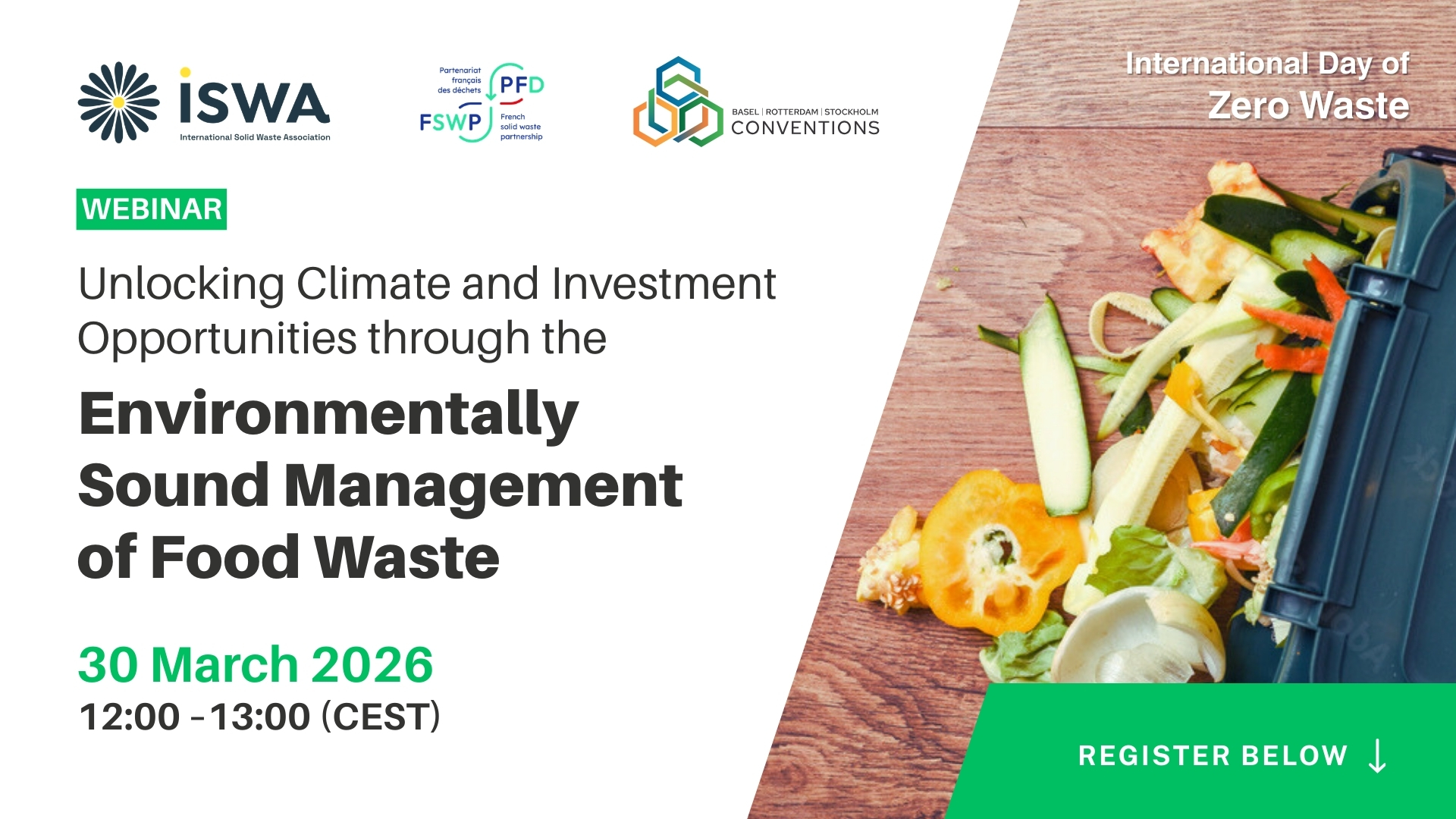
- 30 March 2026 from 12:00 to 13:00 (CEST)
Unlocking Climate and Investment Opportunities through the Environmentally Sound Management of Food Waste
Co-organised with the Basel Convention Household Waste Partnership, ISWA and the Secretariat of the Basel, Rotterdam, and Stockholm Conventions, this webinar examined how the environmentally sound management (ESM) of household organic waste can contribute to global climate goals.
FSWP’s position
A symbol of the growing interest in waste and resources, International Zero Waste Day was an opportunity to highlight projects that are working to rethink the production-consumption relationship in the current linear economy (“extract - produce - consume - dispose”). In this sense, zero waste illustrates the need to undertake the profound, systemic transformations necessary for the transition to circularity. This circular economy, in accordance with the 10R principle, and as reaffirmed in the circular economy action hierarchy of ISO 59004:2024, goes far beyond recycling. The 10R principle, which therefore underpins a profound transformation of our societies in order to address the triple planetary crisis and achieve the 2030 Agenda and SDGs, is broken down as follows:
• Refuse: avoid manufacturing/purchasing unnecessary products;
• Rethink: consider the potential environmental impacts of a product throughout its life cycle before producing or consuming it;
• Reduce: minimize the use of resources and develop more efficient consumption patterns;
• Reuse/repurpose: reuse the product for a second purpose—moving away from an industry based on resource extraction and an economy based on planned obsolescence;
• Repair: combat the throwaway culture, both for consumers and producers, in particular by designing products that are easy to repair;
• Renovate/recondition: restore and modernize an old object to make it as good as new, by changing certain parts;
• Remanufacture: completely remanufacture an object to refurbish it;
• Reuse/upcycle: redefine a new purpose for the object, creatively finding new uses for objects that might otherwise be discarded, thus transforming potential waste into a resource.
• Recycling
• Recovery (energy recovery)As presented by the first eight Rs, the transition to circularity requires upstream waste prevention through material preservation and resource efficiency, not only by producers but also by consumers, by extending the life cycle of products and giving old products a new use or a new life. The private sector is key to making this transition happen. The last two “Rs,” which constitute the lever of prevention, recycling, and energy recovery (“Recovery”), are part of the waste management system and underscore the importance of recovering all existing products to reduce resource extraction.
Zero waste for circularity must ensure sustainable management of goods throughout their life cycle, including their final safe disposal after the 10Rs have been implemented. Although the best waste is no waste at all, there will always be some waste that needs to be managed to protect human health and the environment.
Zero waste therefore has a dual objective: to prevent the generation of unnecessary waste and to ensure that no waste remains unmanaged or poorly managed.
