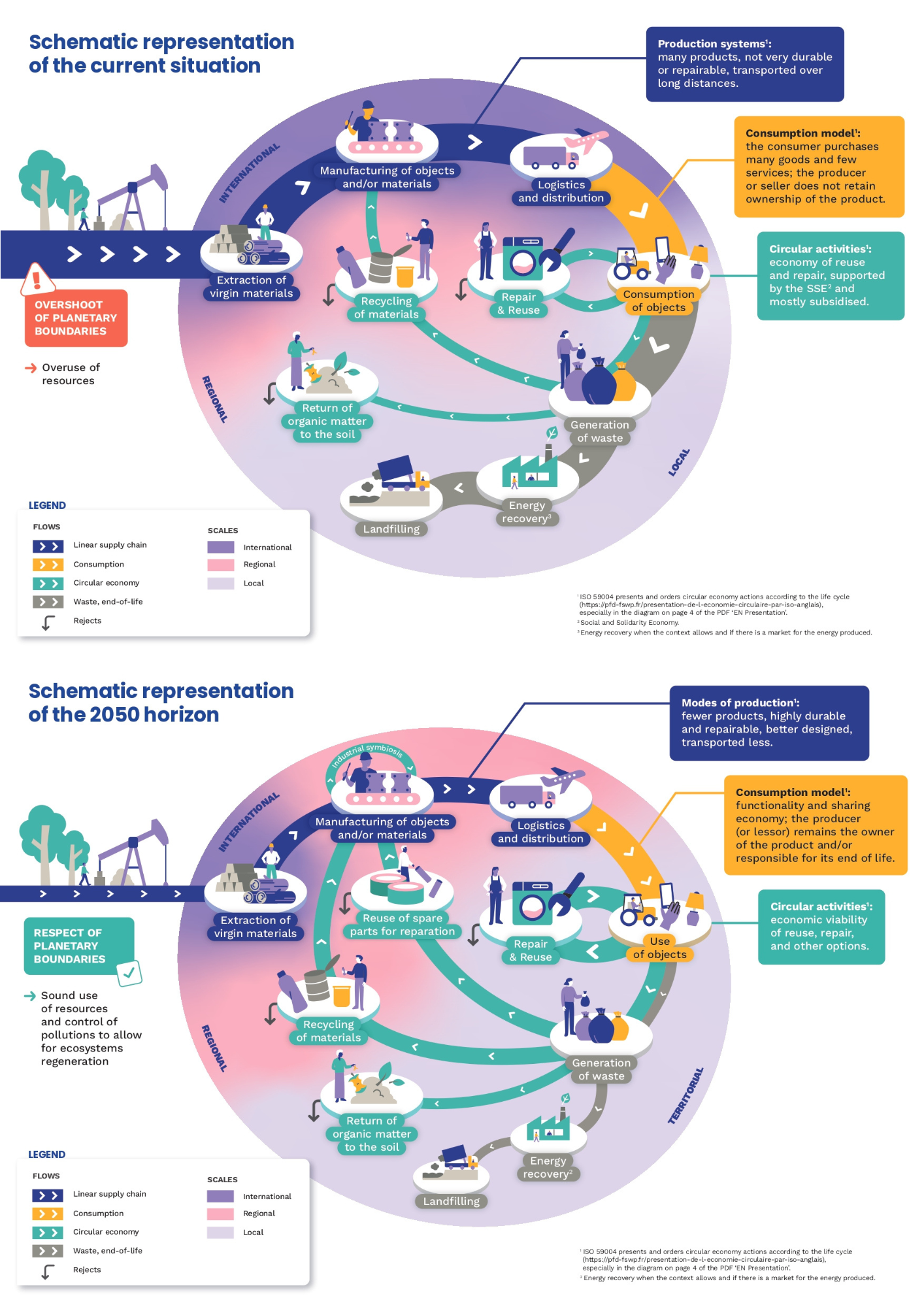
In public debate, circular economy is often reduced to recycling. However, recent international work – in particular the ISO 59004 norm, adopted in 2024, which breaks down the “10R” principle* into 13 actions ordered according to the life cycle – shows that a complete circular economy begins well before recycling and continues well beyond it. Refusing and avoiding some products or uses, rethinking the needs, adapting production through eco-design, reducing resource consumption, reusing, repairing, reconditioning, remanufacturing, repurposing, recycling, recovering energy, and even recovering materials stored in historic landfill sites: these actions form a coherent scale where recycling and energy recovery are at the bottom, once all the levers of reduction, moderation, sustainability, reuse and repair have been activated.
These coordinated actions only make sense when viewed in the context of the three objectives of circular economy: to reduce environmental and health impacts, to maintain an economy that creates value and jobs, and to ensure our societies’ resource sovereignty and resilience.
Given the imperative of ecological, economic and social transition, the French Solid Waste Partnership (FSWP) is contributing to international discussions on what a circular economy could ultimately look like in 2050, both in France and around the world.
Read the full Position Paper about Circular Economy and a 2050 Vision.
To better understand this transition, watch our animated video on it: Transition to a Circular Economy