Sustainable resources and waste management is a key cross-cutting issue for public health, environmental protection, the fight against climate change, the preservation of biodiversity and the transition to more resilient economies implementing the circular economy hierarchy of actions**. It plays an increasingly important role in national and international public policy and contributes directly to the achievement of the 2030 Agenda and its Sustainable Development Goals (SDGs).
While many international initiatives are already working to achieve the SDGs and a 3-D Future by improving the sustainable management of resources and waste, their ambitions remain scattered and fragmented. There are many actors involved — national and local authorities, businesses, financial institutions, international organisations, civil society actors, academia — but they do not yet have a common space to structure dialogue, share experiences and collectively examine the necessary transition pathways. The absence of such a common space and of a shared global vision on waste and resources limits the coherence and impact of international actions.
It was in response to this observation that the international “Global Push” initiative emerged, developed under the impetus of the FSWP (French Solid Waste Partnership), in conjunction with several partners, including ISWA (International Solid Waste Association), UNEP-IETC (United Nations Environment Programme), the Secretariat of the BRS Conventions (Basel, Rotterdam and Stockholm) and UN-Habitat.
The Global Push initiative – Uniting to take action
The initiative aims to bring together stakeholders involved in preventing and managing resources and waste. It also has the objective to trigger coordinated action on a global scale for their improved management, and to support the transition to more circular systems. This is an essential step towards achieving all the SDGs.
The international initiative, while capitalising on existing initiatives working on the subject, is based on a three-pronged approach:
- Developing international frameworks to bring about a dual Global Commitment on Resources and Waste by various stakeholders (states, local authorities and businesses) to: 1/ manage waste in compliance with Environmentally Sound Management (ESM***) throughout the world, and 2/ reduce waste volumes by implementing the circular economy hierarchy of actions, as described in ISO 59004, with the aim of respecting planetary boundaries and reducing dependence on strategic resources. This commitment would provide a common reference framework for public policies, recognising the cross-cutting role of resources and waste management in achieving the SDGs, and strengthening the political and operational mobilisation of stakeholders.
- The creation of a space for discussion between stakeholders on waste prevention and management to strengthen synergies between actors and accelerate the implementation of actions contributing to a shared common goal. The aim is to strengthen synergies between actors and go beyond usual sectoral siloes to achieve the SDGs, and
- Align actors around the implementation of the Global Commitment on Resources and Waste as an essential milestone in achieving the SDGs. The Circularity4allSDGs application could be a tool for project and public policy planners to rethink projects for a positive impact on all SDGs.
The Global Push initiative is a long-term project, currently being consulted on by various international stakeholders, in particular to refine the content of the Global Commitment on Resources and Waste.
Towards a 3-D Future
The way societies manage their waste has evolved over time in response to evolving priorities.
Historically, the main concern was to protect health and keep the immediate environment clean: decontamination was the number one priority. It remains the main reason for closing open dumps, ending open burning of waste, and establishing collection and treatment services that comply with the standards of ESM, as defined by the Basel Convention (Articles 2(8) and 4(2)).
The impact of human activities on the climate then mobilised efforts to reduce GHG emissions: decarbonisation became a priority. This led in particular to improved landfill practices, energy recovery and the reduction of food waste.
More recently, the concepts of planetary boundaries and strategic resources have given rise to the need to reduce resource extraction and waste production while maintaining economic growth, based on profound changes in mindset: decoupling is the new priority. This is the driving force behind the transition to total circularity – the implementation of the 13 actions of the circular economy hierarchy – which also contributes to decontamination and decarbonisation.
Sustainable resources and waste management for a 3-D Future relies on individuals, each in their respective roles and responsibilities, taking action to improve resources and waste management and promote the transition to reduced waste production through the circular economy hierarchy of actions. This approach also leads to a broadening of the concepts of “growth” and “value” beyond their strictly material dimensions to include elements such as resilience, well-being and dignity.
These actions, carried out by individuals in a manner appropriate to each local context and situation, will contribute to the achievement of all SDGs. It should be noted that, due to the diversity of contexts and differences in existing situations, there can be no single path to circularity, waste prevention and management.
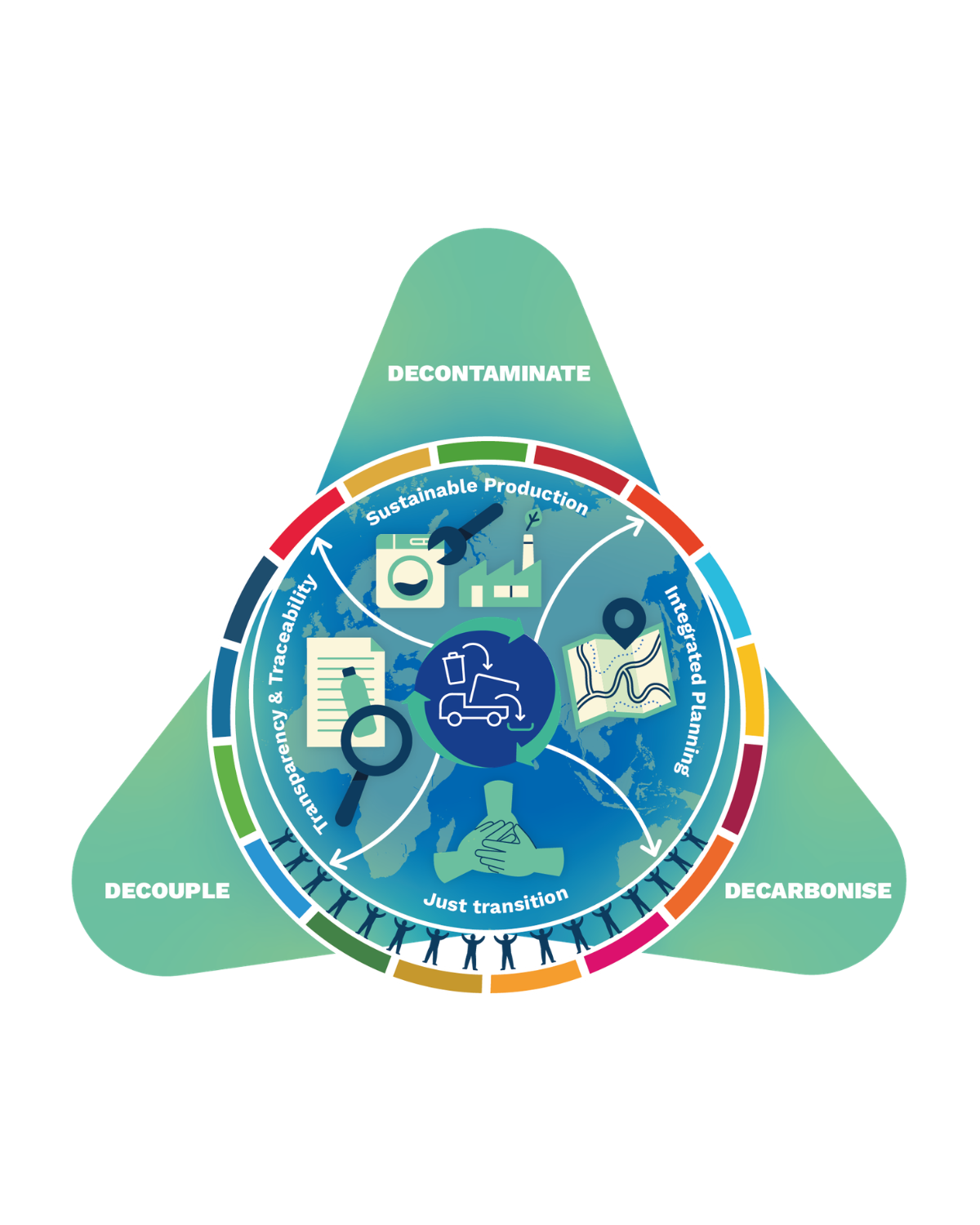
Sustainable and circular resources and waste management is therefore a key success factor in achieving a 3-D future, in which we decouple, decontaminate and decarbonise; a future that protects our health and biodiversity, while strengthening social justice, economic development and well-being.
Towards a Global Commitment on Resources and Waste
The Global Push initiative seeks to make international frameworks evolve with the emergence of a dual Global Commitment on Resources and Waste by various stakeholders to: 1/ manage waste in compliance with ESM throughout the world, and 2/ reduce waste volumes by implementing the circular economy hierarchy of actions, as described in ISO 59004, with the aim of respecting planetary boundaries and reducing dependence on strategic resources.
The implementation of this two-pronged commitment depends on the activation of four enablers, whose components describe concrete actions that can be adopted by the Parties:
– Governance, finance and planning;
– Sustainable production, consumption and use;
– Traceability and transparency; and
– Just transition.
*Decarbonisation means reducing greenhouse gas emissions.
**Refer to ISO Standard 59004 for the list of 13 prioritised actions, also available here.
***Environmentally Sound Management of waste is defined by the Basel Convention (articles 2(8) and 4(2)), which has been ratified by 191 countries. It aims at managing waste in a way that protects both health and the environment.
